GitHub Agentic Workflows Is GA—Should You Self-Host It?
GitHub Agentic Workflows is generally available. This decision guide examines the security boundary, self-hosted runner trade-offs, and safer first use cases.
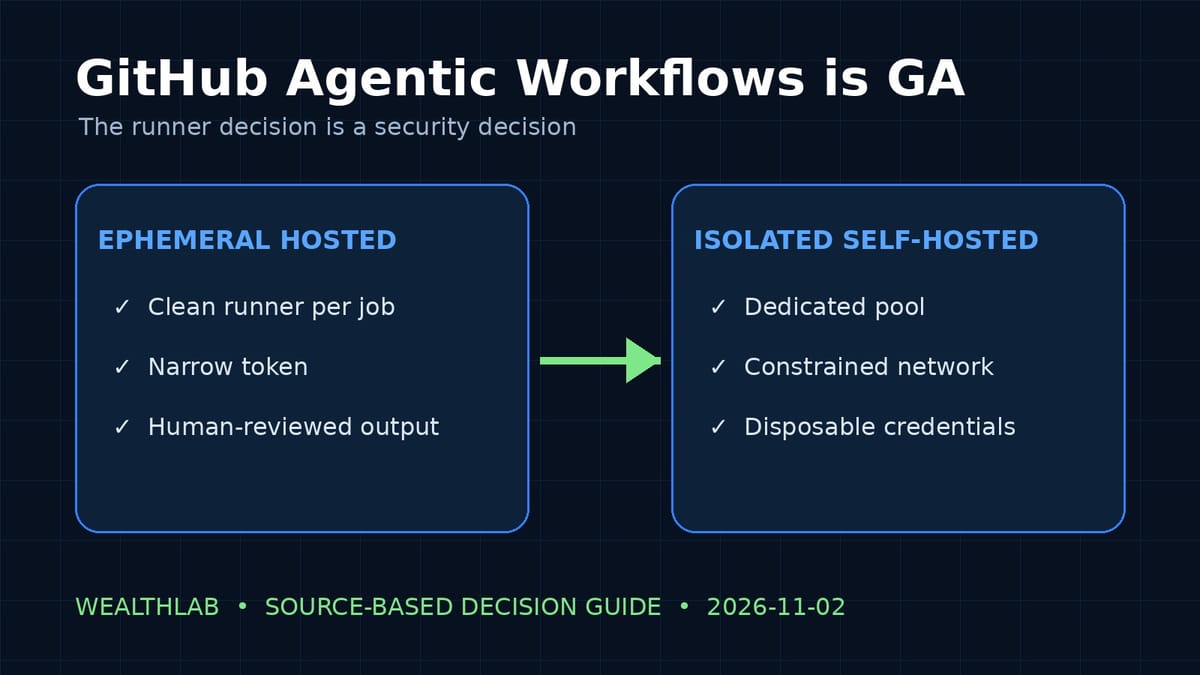
Short answer: GitHub Agentic Workflows reached general availability on October 28, 2026, but GA is not a reason to put an autonomous agent on a long-lived production runner. The best first deployment is a low-impact, read-oriented repository task on an ephemeral GitHub-hosted runner. Self-hosting becomes reasonable when data location, custom tooling, GitHub Enterprise Server, or controlled network access justifies the operational burden—and only after you separate runner, credential, network, and output permissions.
This is a source-based decision guide, not a hands-on deployment review. WealthLab examined GitHub's launch announcement, project documentation, security architecture, self-hosted-runner guidance, an independent technical overview, and academic research on agentic workflow injection. We did not install or execute GitHub Agentic Workflows for this article.
What became generally available
GitHub Agentic Workflows is an open-source GitHub Next project that lets a repository describe an agent task in a Markdown workflow. The gh aw compiler turns that definition into standard GitHub Actions YAML. GitHub lists issue triage, CI failure analysis, documentation updates, and test writing as example workloads. A workflow can use GitHub Copilot or another supported coding agent.
The October 28 announcement says the project is generally available on github.com for GitHub Free, Team, and Enterprise. The important architectural fact is that the resulting automation still runs as GitHub Actions. Existing runner groups and policy constraints remain relevant, but they do not automatically make an agentic job low risk. The agent can reason over untrusted repository content and can produce actions or proposed outputs that ordinary deterministic CI would never invent.
GitHub included internal productivity and error-reduction figures in the announcement. Those are GitHub's own case-study claims, not independent benchmarks, and they should not be generalized to another repository, team, model, or threat environment. This guide therefore uses the release to examine deployment fit rather than to predict productivity gains.
The decision starts with the task, not the runner
A useful first question is not “hosted or self-hosted?” It is “what can this workflow observe, decide, and change?” A daily issue summary that drafts a report has a much smaller failure radius than a workflow that edits code, handles secrets, merges pull requests, or deploys production.
- Good first use: summarize issues, classify an existing backlog, explain a failed test, or draft documentation changes for human review. Keep repository permissions read-only where the task allows it.
- Needs stronger review: generate a pull request, modify labels, post externally visible comments, or use an MCP tool. These add write paths and may turn attacker-controlled text into consequential output.
- Poor first use: merge code, publish packages, rotate credentials, change infrastructure, or deploy production. A reasoning error or injection can cross directly into a high-impact system.
The label “agentic” matters because the path between input and action is not fully predetermined. Restricting the final output is therefore more valuable than hoping a prompt will reject every hostile instruction.
What GitHub's security layers do—and do not—cover
The project describes several layers of defence: a sandboxed agent, a network firewall, read-only permissions by default, safe outputs, lock files, and runtime threat detection. These are meaningful controls, but each covers a different boundary.
- Sandboxing constrains the agent process. It does not decide whether the workflow's intended output is safe to merge or publish.
- Network controls reduce arbitrary outbound access. Required destinations and MCP servers still expand the reachable trust boundary.
- Token permissions constrain direct API authority. They must be reviewed in the compiled Actions workflow, not inferred from the natural-language description.
- Safe outputs provide controlled channels for proposed changes. Human review remains necessary when those changes affect code, users, releases, or infrastructure.
- Lock files help make compiled dependencies reviewable and reproducible. A reviewed lock file does not validate the business intent of a future prompt or issue.
GitHub's own security documentation says prompt injection must be treated as a persistent risk, not a solved problem. Independent research published in May 2026 formalized “agentic workflow injection” in GitHub Actions: attacker-controlled repository content can influence an agent that has access to privileged tools or outputs. The paper is broader than this one GitHub project and should not be read as a claim that every compiled workflow is vulnerable. It does corroborate the underlying threat model.
Hosted runners are the safer default for a pilot
An ephemeral GitHub-hosted runner is discarded after a job, which limits persistence between runs. It also avoids giving the workflow a route to machines, sockets, files, or internal services that happen to be reachable from a permanent homelab or company runner. For a public or ordinary private repository, that is usually the simpler first boundary.
Hosted execution is not permissionless. The workflow still needs a carefully scoped GITHUB_TOKEN, controlled event triggers, reviewed model and tool configuration, and safe treatment of issue bodies, pull-request text, files, logs, and web results. Ephemeral compute reduces persistence; it does not eliminate injection or unsafe output.
A hosted pilot is a poor fit when the task needs local hardware, internal-only dependencies, a private model endpoint, regulated data placement, or GitHub Enterprise Server connectivity. Those requirements can justify self-hosting, but they should be written down before accepting its larger maintenance surface.
What changes on a self-hosted runner
The project supports Linux self-hosted runners. Its documentation says the MCP gateway and sandbox run as containers and warns that Docker daemon access is a privileged host capability. The runner user should access the socket through its owning group; the socket should not be world-accessible.
For Actions Runner Controller (ARC) on Kubernetes, the current guidance requires Docker-in-Docker mode. The containerMode.type="kubernetes" mode is not supported for this path. The DinD sidecar requires privileged: true, and network enforcement occurs inside that Docker daemon's domain. These details are not merely installation trivia: they define where containment and network policy actually live.
A self-hosted runner can also retain more than intended—workspace files, tool caches, Docker layers, logs, credentials left by another job, or access to adjacent services. A container sandbox inside the workflow does not erase the need to harden and recycle the outer runner.
A practical self-hosting decision
Prefer GitHub-hosted runners when the workflow can use standard tooling, does not need internal connectivity, and benefits from job-level ephemerality. This is the default for evaluation and for low-impact repository maintenance.
Consider an autoscaled ephemeral self-hosted pool when you need private dependencies, specific hardware, controlled egress, or enterprise integration. Give the pool a single purpose, use clean instances or pods for each job, isolate it from production networks, and remove registration and workload credentials after termination.
Avoid a shared long-lived runner for untrusted contributions or broad agent workflows. The combination of persistent state, Docker access, repository-controlled inputs, and internal network reach makes the blast radius hard to reason about. If a long-lived runner is unavoidable, do not mix trusted deployment jobs with agentic analysis jobs.
Four boundaries to approve separately
- Input boundary. List every source the model can read: issues, pull requests, committed files, test logs, artifacts, web pages, and MCP responses. Assume external contributors can shape public-repository content.
- Execution boundary. Record the runner image, sandbox runtime, Docker topology, filesystem mounts, egress destinations, host services, and whether the runner is destroyed after one job.
- Authority boundary. Inspect the compiled workflow's token permissions, secrets, environments, tools, and MCP capabilities. Separate read, propose, write, merge, publish, and deploy authority.
- Output boundary. Decide whether the workflow may produce a summary, comment, issue, branch, pull request, package, or deployment. Require human approval before crossing into a higher-impact output.
Do not collapse these into a single “sandboxed” checkbox. A process can be strongly sandboxed while still holding a token that can publish a harmful comment or propose a poisoned patch. Conversely, a read-only token does not make sensitive repository contents safe to send to any model endpoint.
A safer rollout sequence
- Choose one low-impact workflow with a measurable manual baseline and no production side effect.
- Pin the
gh-awtoolchain and inspect both the Markdown source and generated Actions YAML. - Keep token permissions read-only unless a specific output requires more. Do not expose unrelated repository or organization secrets.
- Use an ephemeral runner. If self-hosted, place it in a dedicated pool with constrained egress and no route to production administration surfaces.
- Feed it adversarial test inputs: instructions inside issues, pull requests, files, logs, and fetched pages that attempt to redirect the task or request secrets.
- Route changes through a branch or pull request, not direct pushes or deployment. Require a reviewer who understands the generated diff and the source material.
- Review run logs for denied network requests, unexpected tool use, unsafe-output blocks, and accidental sensitive data. Then test runner cleanup.
- Expand one permission or output at a time. Roll back by disabling the workflow, revoking its credentials, and discarding its runner pool.
Limitations and non-fit cases
General availability indicates a supported release milestone; it does not certify a workflow for regulated data, production deployment, or hostile public inputs. Security also depends on the selected coding agent, repository rules, Actions settings, runner configuration, MCP servers, network policy, and the exact compiled revision.
Do not use the system as an unattended production operator merely because the source is Markdown or because the generated file is ordinary Actions YAML. Natural-language convenience does not reduce the authority of the resulting token, Docker daemon, or API call.
Teams that cannot provide ephemeral execution, scoped credentials, output review, and audit retention should keep high-impact tasks deterministic. Agentic automation is a non-fit when the consequence of a plausible reasoning error is irreversible and there is no independent approval gate.
Evidence boundary and sources
Sources checked November 2, 2026. GitHub is authoritative for the GA date, product availability, current architecture, and runner requirements. The New Stack provides independent reporting on the project's earlier public preview and workflow model. The May 2026 research paper provides independent evidence for the general injection class; it does not prove exploitation of every current GitHub Agentic Workflow.
- GitHub Changelog: GitHub Agentic Workflows generally available — GA date, availability, workflow examples, and vendor case-study claims.
- GitHub Agentic Workflows documentation — architecture and layered security model.
- Self-Hosted Runners reference — Linux, Docker, ARC, DinD, socket, and pod-security requirements.
- The New Stack: GitHub's Agentic Workflows bring continuous AI into CI/CD — independent overview of the workflow model and initial release.
- Demystifying and Detecting Agentic Workflow Injection Vulnerabilities in GitHub Actions — independent research on the workflow-injection threat class.
No local installation, runner benchmark, injection exploit, or production workload test was performed. This article contains no affiliate links.
Related WealthLab guides
- Install Hermes Agent on Linux — plan the host, identity, and access boundary for another agent runtime.
- GitHub Copilot local sandboxing — distinguish process isolation from ordinary directory separation.
- Agent Skills under AAIF — review portable agent packages as a software supply chain.
- Docker Sandboxes and the eMudhra CA compromise — understand why a sandbox still depends on its image and certificate supply chain.
Related GitHub security analysis
- GitHub’s pull_request_target default block — identify affected public repositories and choose an explicit event policy before December 2.