GitHub Copilot Global Defaults: Audit Unconfigured Features
GitHub is applying Copilot's global default to eligible unconfigured features through October 26. Audit policy inheritance before access changes silently.
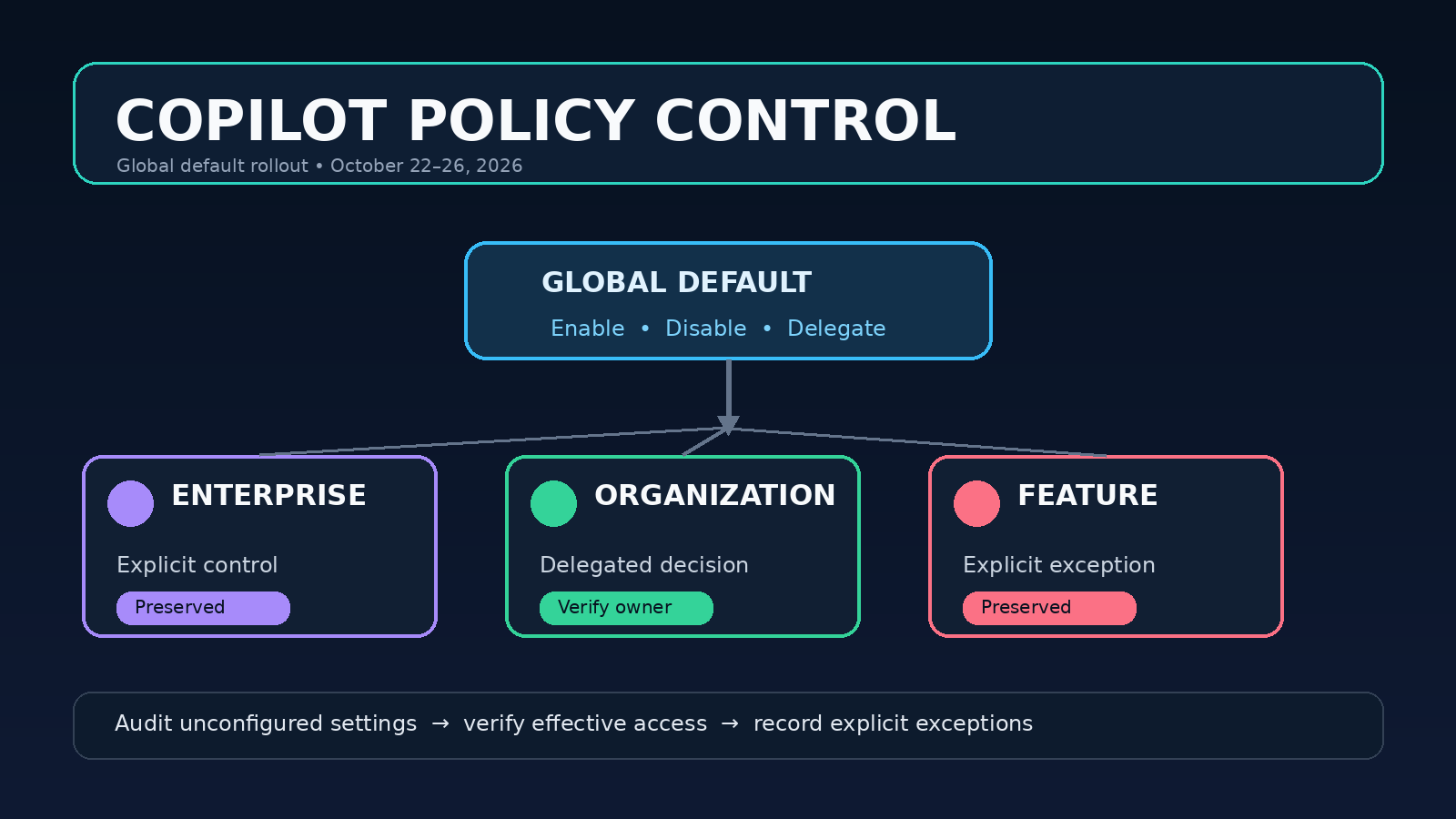
Quick answer: GitHub began enforcing its global default policy for eligible GitHub Copilot features on October 22, 2026, with a gradual rollout through October 26. On Copilot Business and Copilot Enterprise, eligible generally available features left Unconfigured are set once according to the selected global default. Explicit per-feature choices are preserved. Administrators should inventory unconfigured settings now, decide which features need explicit controls, and verify effective policy at both enterprise and organization levels.
This is a source-based operator analysis. WealthLab reviewed GitHub's dated rollout notice, current default-availability documentation, and enterprise policy guidance. We did not administer a Copilot tenant or observe the rollout in an enterprise. The article does not claim that a specific tenant, feature, or user changed state.
What changed on October 22
GitHub's October 22 changelog says enforcement is rolling out gradually through October 26, so different enterprises and organizations can see the change at different times. The policy applies to eligible settings on Features & clients and to MCP servers in Copilot. GitHub's default-availability documentation also identifies Copilot code review on the Agents page as in scope.
The key mechanism is inheritance. An eligible generally available feature that remains Unconfigured is assigned according to the effective global default: enabled, disabled, or delegated so organizations decide. GitHub says this rollout assignment is a one-time change. Changing the global default later does not rewrite feature policies that have already been set.
Why “unconfigured” is an active policy decision
An unconfigured field can look like an absence of policy, but during this rollout it is an instruction to inherit another policy. GitHub's documentation says the feature default is enabled by default. An administrator who has not reviewed the setting can therefore receive broader feature availability without editing each feature individually.
This is not necessarily unsafe or undesirable. Automatic availability can reduce administrative delay and make generally available capabilities usable sooner. The risk is governance drift: access may no longer match an organization's data-handling rules, approved development workflow, MCP-server policy, or change-control expectations.
Understand the policy hierarchy
- Enterprise: Enabled everywhere. Eligible unconfigured GA features are enabled for Copilot users, and organizations cannot disable them.
- Enterprise: Disabled everywhere. Eligible unconfigured GA features are disabled, and organizations cannot enable them.
- Enterprise: Let organizations decide. Control is delegated. Each organization's own default determines eligible features that the organization has not explicitly configured.
- Explicit feature choice. A feature already enabled or disabled is preserved by this rollout and no longer follows a later change to the feature default.
- Preview feature. The global feature policy does not generally apply while a capability remains in preview. GitHub says an existing preview opt-in is preserved when that feature becomes generally available; otherwise the default can apply when it becomes eligible.
Do not confuse this feature policy with GitHub's separate default-availability policy for models. GitHub documents them as independent controls with different eligible states and exceptions.
Settings that deserve explicit review
MCP servers in Copilot
GitHub expressly includes the MCP-server policy in the feature-default scope. That makes it more than a user-interface preference: MCP can connect an agent to tools and external data. Review which servers are permitted, how credentials are scoped, what actions require approval, and whether a server exposes production or sensitive systems. A global enablement decision does not validate every server configuration.
Copilot code review and agent capabilities
GitHub identifies Copilot code review as eligible, while other feature and client controls can also inherit the default. Availability does not turn an AI review into an enforceable merge gate or remove the need for deterministic tests, rulesets, human review, and least-privilege execution. Record which control is advisory and which control can actually stop a change.
Organization delegation
“Let organizations decide” is useful when business units have different risk profiles, but delegation needs an owner. Confirm every organization has an intentional default, identify who can change it, and set a review date. Otherwise the enterprise has moved the unresolved decision rather than completed it.
Administrator action checklist
- Open the effective control. Review AI Controls → Copilot → Default policy for new features at the enterprise level and at every delegated organization.
- Count unconfigured eligible policies. GitHub says the interface shows how many eligible policies are unconfigured. Export or record the list rather than relying only on the count.
- Classify by capability and data path. Separate editor conveniences from agent actions, MCP access, code review, cloud session behavior, and controls that can reach external systems.
- Set explicit exceptions first. Explicitly enable or disable features whose risk, contractual, residency, or workflow requirements differ from the global posture.
- Review both levels. An enterprise delegation can leave the real result dependent on an organization's default. Verify the final effective policy, not only the parent setting.
- Check plan and eligibility. This rollout applies to Copilot Business and Copilot Enterprise. Feature eligibility and documented exceptions can change; use the current GitHub UI and documentation.
- Preserve enforcement layers. Keep branch protections, rulesets, secret scanning, tests, approval gates, endpoint controls, and sandbox policy independent of Copilot feature availability.
- Record before and after state. Capture the review date, policy owner, global value, explicit exceptions, and expected effective result. Recheck after the rollout reaches the tenant.
- Prepare a rollback decision. Know which individual feature to disable if a workflow or compliance issue appears. Changing only the global default will not retroactively rewrite policies already assigned by the rollout.
Fit and non-fit cases
Enabled by default can fit: organizations with a defined Copilot governance process, rapid feature evaluation, scoped credentials, controlled MCP access, and monitoring that can detect unexpected adoption.
Disabled by default can fit: regulated or high-assurance environments that require feature-by-feature assessment, change tickets, legal review, data-flow approval, or customer-specific controls before use.
Delegation can fit: enterprises whose organizations have genuinely different requirements and named local administrators. It is a poor fit when no one owns the organization-level review.
None of these settings proves: that an agent is safely sandboxed, that a specific MCP server is trustworthy, that generated code is secure, or that users follow the intended approval workflow.
Verification after the rollout
After GitHub applies the policy to the tenant, sample the enterprise and each delegated organization. Confirm the global value, inspect the features that were previously unconfigured, and compare the observed state with the recorded expectation. Test access with a non-administrator account where appropriate, but do not connect new MCP servers or production credentials merely to prove availability.
If the result is wrong, change the individual feature explicitly. Because GitHub describes the rollout as a one-time assignment, changing the global feature default alone is not a reliable rollback for policies that are no longer unconfigured.
Related WealthLab guides
- GitHub Copilot local sandboxing checklist — constrain what local agent commands can reach after the feature is available.
- GitHub AI Scan merge-gate limits — distinguish advisory AI findings from enforceable repository controls.
- Install Hermes Agent on Linux safely — apply least privilege and explicit approval to another agent workflow.
- VPS firewall checklist for Docker apps — keep production network controls separate from developer-tool availability.
Evidence boundary and sources
Sources checked October 24, 2026:
- GitHub Changelog, October 22, 2026 — rollout window, one-time assignment behavior, preserved explicit choices, scope, and preview treatment.
- GitHub Docs: default availability of Copilot features and models — policy hierarchy, default state, eligible controls, exceptions, and distinction between feature and model defaults.
- GitHub Docs: managing Copilot policies for an enterprise — current administrative workflow and enterprise-level controls.
- GitHub Community rollout discussion — vendor-hosted discussion channel linked from the announcement; useful for rollout questions, not independent validation.
No hands-on tenant audit was performed. GitHub is the authoritative source for this account-policy change; no independent publication available during research established different rollout mechanics. Exact labels, eligibility, exceptions, and timing may change after publication, so verify the current documentation and effective settings in the tenant.
This analysis is non-commercial and contains no affiliate links.