Docker Engine 29.9.1: containerd Image-Pull Security Checklist
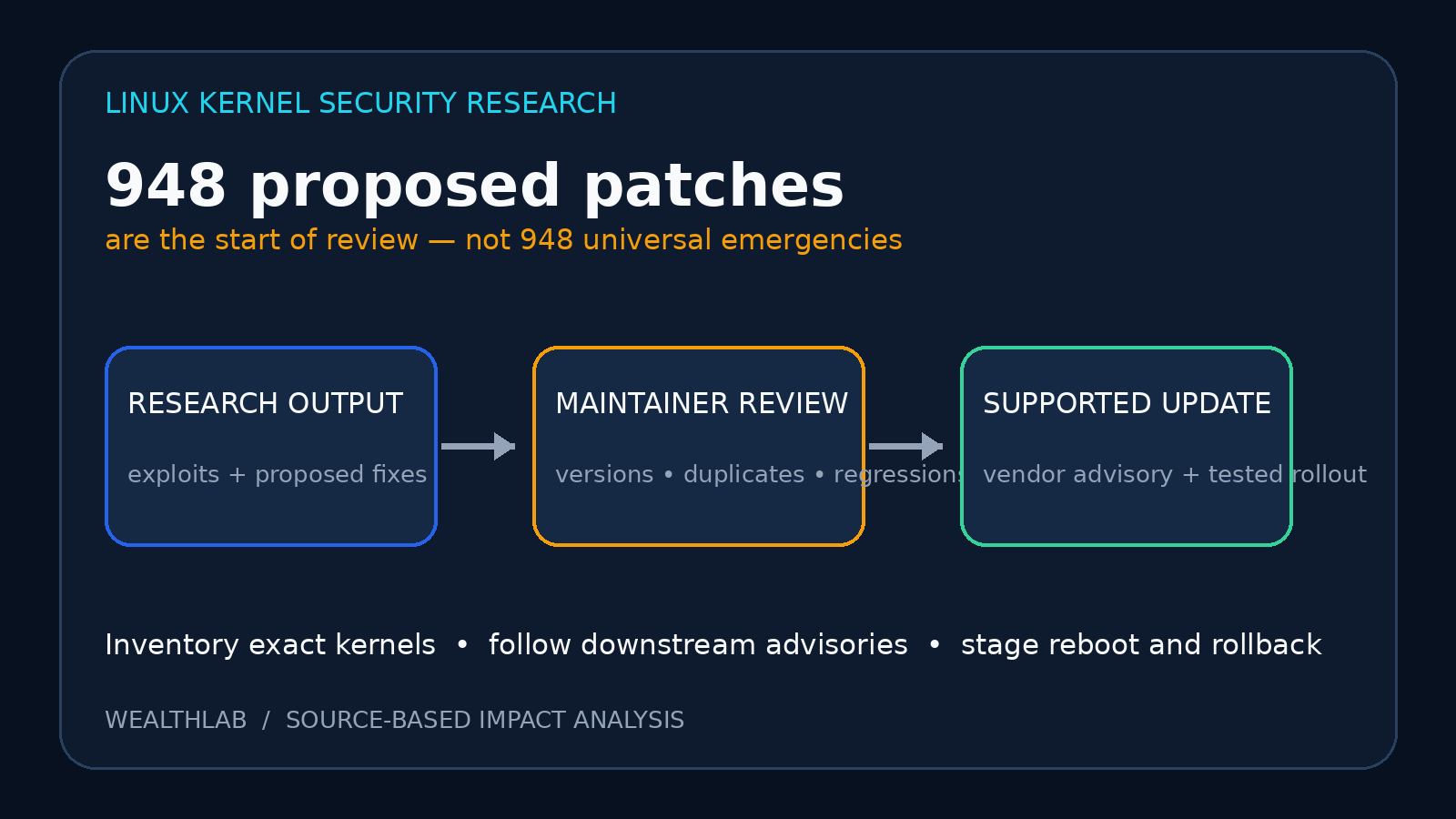
Docker Engine 29.9.1 updates containerd for three image-pull flaws involving daemon crashes and host disk exhaustion. Check runtime versions, registry trust, capacity, and rollback readiness.
Quick answer: Docker Engine 29.9.1, released October 14, 2026, updates its bundled containerd to 2.4.2 and lists three medium-severity containerd security fixes. Two flaws can crash the containerd daemon during a crafted image pull; the third can consume host disk space with an unbounded layer stream. Operators who accept untrusted image references, pull through untrusted registries, or run multi-tenant Kubernetes nodes should prioritize the update. Before changing production, confirm the containerd version actually in use, back up relevant state and configuration, test the supported package path, and keep a rollback decision—not merely an old binary.
This is source-based operator analysis published October 16, 2026. WealthLab did not reproduce the flaws, pull crafted images, patch a production host, or validate rollback. This article contains no affiliate links.
What changed in Docker Engine 29.9.1?
Docker's 29.9.1 release notes say the containerd update to 2.4.2 includes fixes for three vulnerabilities disclosed by the containerd maintainers on October 13. The Docker release was published on October 14. The fixes concern image ingestion rather than an application running inside an already-started container:
| Advisory | Trigger described by maintainers | Operator impact | Patched containerd lines |
|---|---|---|---|
| CVE-2026-95839 / GHSA-vwhp-8p66-mq4f | A child image descriptor has the subject annotation and a malformed digest | Unrecovered panic can crash containerd; repeated Kubernetes pull retries can disrupt node operations | 2.2.10, 2.3.7, 2.4.2 |
| GHSA-8647-2jxj-p2rc | An untrusted registry sends a crafted Content-Length while parallel layer fetch is enabled | Memory-allocation panic can crash containerd and block new operations until service recovery | 2.2.10, 2.3.7, 2.4.2 |
| GHSA-hc94-p972-ch66 | A crafted image or malicious registry streams layer data beyond the declared size | Host disk exhaustion can create disk pressure, stall containerd or kubelet, and block new workloads | 2.0.14, 2.2.10, 2.3.7, 2.4.2 |
Those fixed versions are the containerd project's version lines. Docker Engine 29.9.1 is the upstream Docker package named in Docker's release notes. Distribution vendors and managed platforms may backport fixes without adopting the same top-level version, so verify the vendor advisory and installed package rather than judging only by a version string.
Who should act first?
- Higher priority: Kubernetes or container platforms where tenants, CI jobs, developers, or deployment systems can reference images outside a tightly controlled registry set.
- Higher priority: hosts using registry mirrors, proxies, or third-party registries whose responses cross a trust boundary.
- Higher priority: nodes with limited free disk, shared runtime capacity, weak disk-pressure alerts, or slow operational recovery.
- Configuration-specific priority: the crafted Content-Length crash applies when
concurrent_layer_fetch_bufferenables parallel layer fetching. The advisory says the default disabled configuration is not affected by that specific flaw. - Still review: single-operator Docker hosts that pull only pinned images from controlled registries. Their exposure is narrower, but a compromised registry or trusted publishing path can still supply hostile image metadata or data.
This is not evidence that an existing container, image, registry, or host was compromised. The published impacts are denial of service and resource exhaustion during image pulling or importing. Treat unexplained runtime crashes, disk growth, or image-pull failures as investigation signals, not automatic proof of exploitation.
Check the runtime you actually use
- Identify the path. Record whether the host uses Docker Engine's bundled runtime, a distribution containerd package, Kubernetes-managed packages, Docker Desktop, or a managed service. Remediation ownership differs.
- Record versions and package sources. Capture
docker version,containerd --versionwhere directly available, and the operating system package version. Avoid changing anything during this inventory step. - Check vendor status. For upstream Docker Engine, review 29.9.1. For another distribution or managed platform, use its maintained advisory because a backported fix may retain an older-looking version.
- Review registry trust. List registries, mirrors, pull-through caches, CI-controlled image names, and any user-supplied image fields. “Private” does not automatically mean trusted if many identities can publish.
- Inspect the parallel-fetch setting. Determine whether
concurrent_layer_fetch_bufferis explicitly nonzero under the relevant containerd transfer or CRI image plugin. Do not assume the setting from a generic example.
Safe update checklist
- Preserve evidence before cleanup. If containerd has crashed or disk use has surged unexpectedly, save relevant service logs, timestamps, image references, registry endpoints, deployment events, and disk-usage evidence before restarting or pruning.
- Back up configuration and workload state. Preserve runtime configuration, Compose manifests or cluster declarations, secrets through their normal protected backup path, and application data independently of container layers.
- Confirm capacity. Check free space and inodes for the containerd or Docker data filesystem. Set a practical alert threshold; do not rely on a failed pull being harmless.
- Use the supported update channel. Apply Docker Engine 29.9.1 where it is the correct upstream package, or the distribution or platform update that explicitly carries the containerd fixes. Do not replace a managed runtime manually.
- Stage where possible. Validate image pulls from approved registries, container restart behavior, networking, storage mounts, health checks, and orchestrator scheduling before broad rollout.
- Roll out deliberately. Drain or isolate clustered nodes according to the platform's procedure. On a standalone host, account for the restart window and workloads that do not tolerate interruption.
- Verify after update. Re-read the running runtime and package versions, pull a known approved image, start a disposable benign workload, confirm existing applications, and inspect runtime and kernel logs for errors.
Temporary risk reduction when patching is delayed
The containerd advisories recommend restricting image references to trusted registries. In Kubernetes, they point to admission controls such as a ValidatingAdmissionPolicy or admission webhook. That control should validate the registry and, where appropriate, repository and digest—not merely match a loose substring.
For GHSA-8647-2jxj-p2rc, the maintainer workaround is to keep concurrent_layer_fetch_buffer at 0 or omit it under the documented transfer and CRI image-plugin sections. This only addresses the configuration-specific crash; it does not fix the malformed-digest crash or unbounded-layer disk exhaustion.
- Pause optional pulls from unknown registries and disable user-controlled image references where feasible.
- Prefer approved repositories and immutable digests, while remembering that digest pinning identifies content but does not make hostile content safe.
- Watch containerd or Docker restarts, failed image pulls, filesystem growth, inode consumption, and node disk-pressure events.
- Avoid emergency broad pruning before evidence collection. Pruning can remove useful artifacts and can delete recoverable caches without addressing the vulnerable pull path.
Rollback is an operational decision
A rollback plan should identify the previous supported package, configuration compatibility, workload interruption, data and metadata boundaries, and the condition that triggers rollback. Rolling back to a vulnerable runtime restores service at the cost of known exposure, so combine it with registry restrictions and monitoring while a corrected deployment is prepared.
Do not call rollback “verified” because a package can be downgraded in a test command. Verify the actual application recovery path: daemon health, approved image access, workload startup, persistent storage, networking, and orchestrator state. WealthLab did not perform that validation for this release.
What not to conclude
- Do not infer compromise from the presence of a vulnerable version alone.
- Do not assume every Docker Engine version before 29.9.1 is affected in exactly the same way; the published affected ranges are for containerd 2.x, and vendors may package or backport differently.
- Do not treat a registry allowlist as a complete fix. A trusted publishing identity or mirror can still be compromised.
- Do not confuse running-container continuity with host safety. One advisory says existing containers remain running after the daemon crash, while disk exhaustion can affect wider host operation.
- Do not test the issue against production with crafted images or malicious registry responses.
Evidence boundary and corroboration
WealthLab compared Docker Engine 29.9.1 release notes with containerd 2.4.2 release notes and the three public maintainer advisories. Their dates, affected version ranges, prerequisites, fixed versions, impacts, and workarounds agree. At the time checked, NVD's API returned no record for CVE-2026-95839, and the other two advisories did not list CVE identifiers; no independent incident report was used. Accordingly, this article does not claim exploitation in the wild, independent reproduction, or a complete vendor-by-vendor package map.
Related WealthLab guides
- Docker VPS Production Checklist
- VPS Firewall Setup for Docker Apps
- Docker Hub CVE-2026-105445 operator response
- Ghost Docker Backup and Restore Guide
Sources checked October 16, 2026
- Docker Engine 29.9.1 release notes — upstream Docker release and bundled containerd security-update summary.
- containerd 2.4.2 release notes — runtime release, security links, and additional hardening changes.
- CVE-2026-95839 advisory — malformed-digest crash scope, fixed versions, and registry-trust workaround.
- GHSA-8647-2jxj-p2rc advisory — crafted Content-Length crash prerequisite, fixed versions, and configuration workaround.
- GHSA-hc94-p972-ch66 advisory — unbounded layer-stream disk-exhaustion scope and fixed versions.
Related security review
- Docker Sandboxes after the eMudhra CA compromise — refresh sandbox trust stores without mistaking a CLI update for remediation.
Related supply-chain guidance
- Docker Content Trust retirement migration checklist — inventory legacy signing and replace verification before the December shutdown.
Related runtime security
- Node.js October 2026 security release checklist — update the application runtime inside container images, then verify the deployed digest.